Earring RFQs: Confirm the Spare-Component Offer
For an earring spare-component enquiry, ask the manufacturer whether it offers any components separately for the exact finished model under discussion. Keep the actual part reference and its commercial scope distinct from the complete earring offer. A photograph of assembled jewellery identifies an appearance; it does not establish which parts, if any, the supplier makes available as spares.
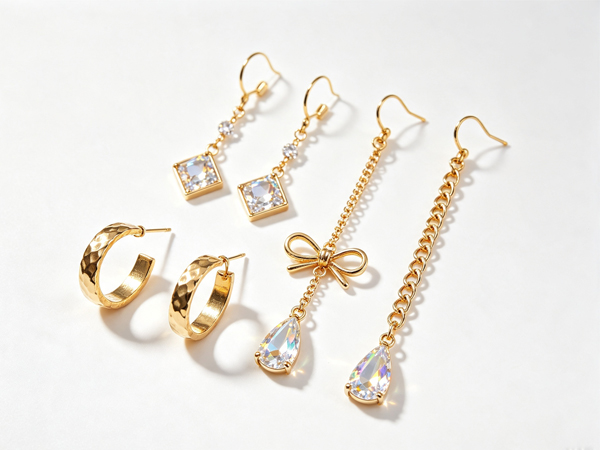
Official homepage jewellery-category reference. The arrangements do not establish one supplied set, shared spare parts, metal composition or gemstone identity.
Identify the finished model before asking about spares
Dingjia’s linked product listing uses the general name Earrings. Its homepage shows additional hoop and hanging designs as jewellery-category references. Use the actual product reference and the manufacturer’s offered model identifier in the enquiry. A broad request for earring parts can otherwise leave the supplier unsure which finished item the proposed component should be associated with.
Ask the manufacturer to identify the product version covered by its reply. If it does not use a separate model code, retain the name and the reference it provides to distinguish the item. Keep another design on its own record. Different silhouettes and visible closures should not be treated as evidence that the same component is offered or applicable across all photographed earrings.
Ask which components are actually offered separately
Ask the supplier whether any spare or replacement component forms part of its actual commercial offer for the identified model. If it offers one, request the component name and reference it uses. If it does not offer separate parts, retain that answer with the enquiry. The buying record should reflect the manufacturer’s proposal rather than a component list created from a product photograph.
Keep a separately offered component distinct from a part fitted within a finished earring. Visible hooks, hoops, links or decorative elements can help point out the area being discussed, but their appearance does not prove separate availability. Ask the manufacturer to state the commercial scope it actually provides. Do not turn every visible element into an assumed spare item or an available repair service.
Official homepage jewellery-work reference. It does not verify a particular factory operation, ownership, employee, material, development service or timeline.
Keep included, optional and excluded scope explicit
Ask whether an identified component is included with a finished-item proposal, offered on a separate line, or outside the supplier’s offer. Keep that status with the actual part reference. A proposed spare should have its own clear correspondence to the commercial item, so that a buying team does not confuse a fitted part with an additional loose component.
Request the applicable commercial description from the manufacturer where a component is offered separately. Retain the supplier’s actual reply for quantity units, conditions or other quotation details. Do not invent a spare quantity, a minimum order, a price or a delivery promise from the finished-product catalogue. The purpose is to identify what the supplier offers, not to assume a separate component business from a jewellery display.
Buying field
Requested supplier response
Finished item
Exact offered earring model and version identified by the manufacturer.
Component identity
Supplier name or part reference for a separately offered component, if any.
Offer status
Included, separately proposed or excluded scope stated by the supplier.
Model association
The finished version to which the manufacturer associates the component.
Applicable reference
Available manufacturer document or identified sample supporting that association.
Commercial correspondence
Current quotation line and remaining component-scope questions.
Request a model-specific applicability reference
If a part is offered, ask the manufacturer which model and version it describes. Retain any available part specification, reference view or sample identifier with the supplier’s statement. A visually similar component in another earring should not be treated as interchangeable without the actual manufacturer association. Keep any proposed alternative separately identified in the enquiry.
This is an applicability and commercial-scope question. It does not establish repairability, fitting performance or a tested service life. Ask the supplier to identify the information it actually provides for the offered part. Do not create a removal, disassembly or installation procedure from a catalogue picture, and do not infer that a part shown in one jewellery arrangement is suitable for another.
Keep the sample and component offer connected
Where the manufacturer offers a component sample, ask which part reference and finished product it represents. Keep the reply with the sample identifier and the current quotation. A complete earring sample and a separately offered component sample can serve different discussions. The manufacturer should state their relationship rather than leaving that association to the buyer’s interpretation.
If the supplier proposes a changed part or another product version, ask whether the existing applicability statement still covers it. Retain the current reply and the reference it replaces. This gives the purchasing team a record of the actual proposal without carrying an old component association into a different offer. Unanswered scope remains a supplier question, rather than an assumed compatibility result.
Separate official product-page appearance reference. Its parts and offered version need manufacturer identification; other homepage earring designs are not confirmed variants or compatible assemblies.
Use the homepage images within their actual scope
The homepage display groups several jewellery appearances, and a separate image shows jewellery-related work references alongside small objects and a sketch. Those images do not establish a spare-parts catalogue, available component quantities or the sequence of an actual factory operation. The linked Earrings product image also represents a separate appearance that needs its own offered-product identification.
Keep the manufacturer’s actual finished-model and component statements with the enquiry. A completed record should identify whether any spare is offered, which part reference the supplier uses and which finished version it applies to. It should also preserve a reply that no separate component is available. This answers an after-sales sourcing question without treating photographed parts as a promise of supply or interchangeability.
Buyer FAQ
Does a visible part in an earring photograph mean it is available as a spare?
Ask the manufacturer whether it actually offers that component separately for the identified model.
Can similar-looking components be assumed interchangeable?
Request the manufacturer’s applicable model and part reference rather than inferring compatibility from appearance.
Should a spare be assumed included with every finished pair?
Ask the supplier to identify included, separately offered or excluded scope in the actual commercial proposal.
What if the supplier offers no separate components?
Retain that answer with the finished-product reference and keep it visible in the purchasing discussion.
Use the Earrings product reference, keep other homepage jewellery appearances distinct, and ask for the actual component offer and model association.
Identify the finished model before discussing a separate part.
Request the actual component offer and its applicability.
Keep the part reference and commercial correspondence together.
earring spare component offer scopeB2B supplier sample record